Understanding Measurement Reliability and Validity
A concerned parent takes their child to a psychologist to be assessed for ADHD. The clinician runs a battery of tests and concludes the child has the disorder. Seeking a second opinion, the parent visits a different psychologist a week later. Using the same tools, this new clinician concludes the child does not have ADHD, but rather mild anxiety.
Confusing, right? This scenario highlights one of the most critical challenges in clinical psychology and research: Measurement Reliability.
Just as a manufacturing company needs to know if their calipers are accurately measuring metal rods, psychologists must ensure their assessment tools (gauges) are measuring human behavior consistently. In the industrial world, this is called Measurement System Analysis (MSA) or Gauge R&R. In psychology, we call this Psychometrics.
If our “gauge”—be it a depression inventory, an IQ test, or a behavioral observation checklist—is flawed, we risk making life-altering mistakes. Today, we will dive deep into the statistical backbone of psychological testing, exploring how we distinguish true patient differences from measurement error.
What is Measurement System Analysis in Psychology?
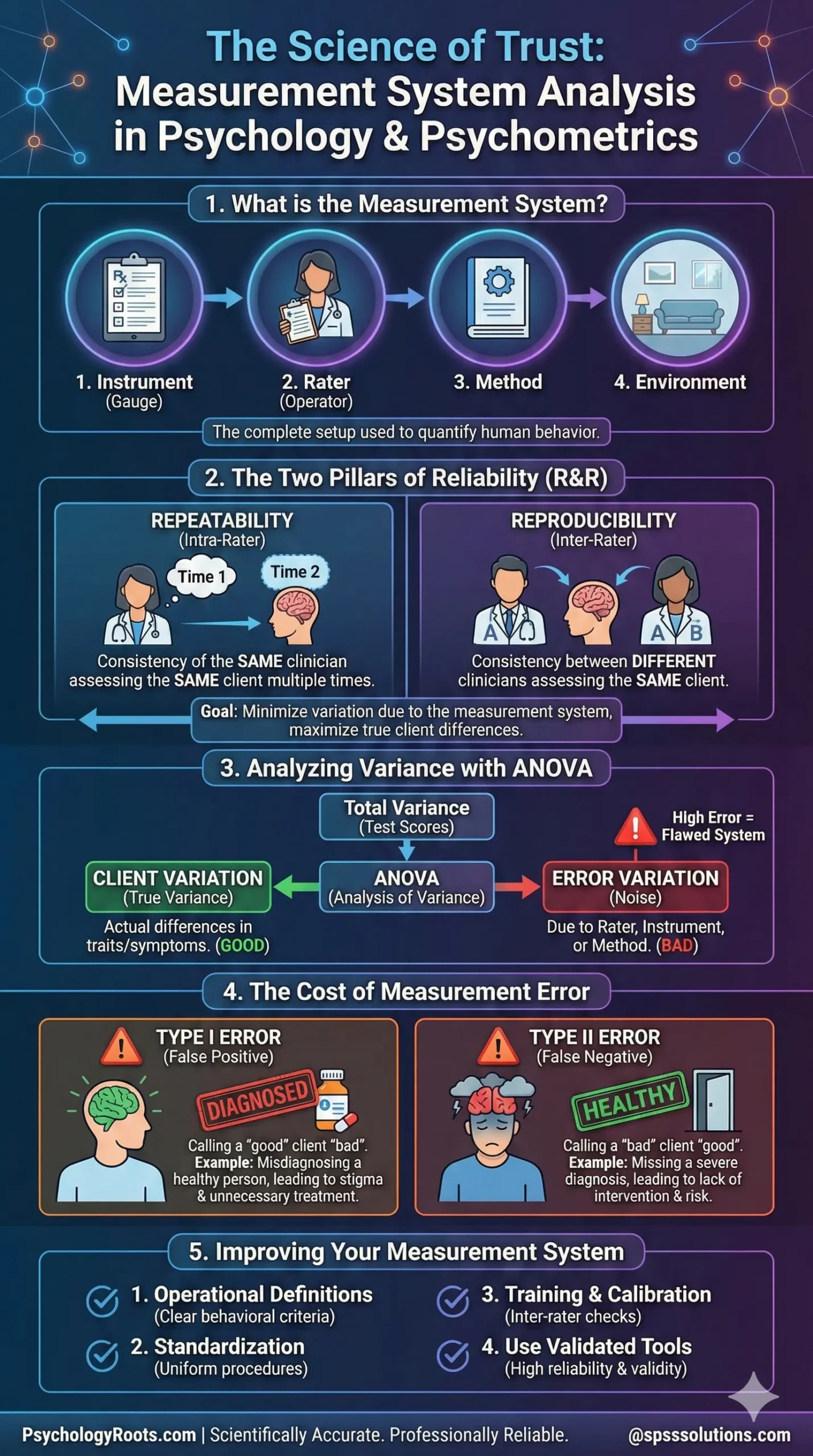
In psychology, a “measurement system” isn’t just the paper-and-pencil test or the iPad app used to score a patient. It is a complex combination of:
The Instrument (Gauge): The specific test (e.g., Beck Depression Inventory, WAIS-IV).
The Rater (Operator): The psychologist or researcher administering the test.
The Method: The standard operating procedure (e.g., standardized instructions).
The Environment: The setting in which the test is taken (quiet room vs. busy hospital).
When we analyze this system, we are asking a fundamental question: Is the variation we see in test scores due to actual differences between patients (True Variance), or is it just “noise” from the test or the clinician (Error Variance)?
To answer this, we look at two critical components: Repeatability and Reproducibility.
The Two Pillars of Reliability: R&R
In the provided text, the concept of “Gauge R&R” stands for Repeatability and Reproducibility. In psychometrics, these terms map directly to how we validate our assessment tools.
1. Repeatability (Intra-Rater Reliability)
Repeatability refers to the consistency of scores when the same clinician assesses the same client using the same instrument multiple times under identical conditions.
The Goal: If I measure your anxiety levels today, and then again in an hour (assuming your state hasn’t changed), I should get the same score.
The Reality: If the test items are vague or the clinician is tired, the scores might fluctuate. In psychology, we often measure this via Test-Retest Reliability (stability over time) or Intra-rater Reliability (consistency of the same rater).
Psychological Example: A researcher coding a video of child behavior should code the same aggression event the same way if they watch the video twice.
2. Reproducibility (Inter-Rater Reliability)
Reproducibility measures the variation that occurs when different clinicians assess the same client using the same instrument.
The Goal: Dr. A and Dr. B should both be able to administer the Rorschach test to Patient X and come to similar scoring conclusions.
The Reality: Humans are subjective. If Dr. A is strict and Dr. B is lenient, the “measurement” is contaminated by the rater’s bias. This is a massive issue in diagnostic interviews.
Psychological Example: If two psychiatrists interview a patient and one diagnoses Bipolar Disorder while the other diagnoses Borderline Personality Disorder, the diagnostic system has low reproducibility (poor inter-rater reliability).
Analyzing the Data: The Role of ANOVA
How do we mathematically calculate this error? As highlighted in statistical analysis, we use a method called ANOVA (Analysis of Variance).
In a clinical research setting, ANOVA helps us partition the variance—splitting up the “noise.”
Part Variation (Client Differences): This is the “good” variation. We want the test to show differences between a client with severe depression and a client with mild sadness.
Operator Variation (Clinician Bias): This is “bad” variation. If the ANOVA shows a significant p-value (< 0.05) for the “Operator,” it means the test scores depend more on who is testing rather than who is being tested.
If your data shows that 30% of the variance in diagnosis is due to the clinician (Operator), your measurement system is flawed. In industry, a measurement system with >30% error is considered unacceptable. In clinical psychology, such a margin could lead to malpractice or harmful treatment plans.
Why Precision Matters: The Cost of Error
The transcript mentions two costly mistakes in manufacturing: calling a good part “bad” and a bad part “good.” In psychology, these errors have human faces:
Type I Error (False Positive): “Calling a good part bad.”
Scenario: A healthy individual is wrongly diagnosed with Schizophrenia.
Consequence: Unnecessary medication (antipsychotics), stigma, and psychological distress.
Type II Error (False Negative): “Calling a bad part good.”
Scenario: A suicidal patient is assessed as “low risk” and sent home.
Consequence: Failure to intervene, leading to potential tragedy.
A solid measurement system minimizes these errors, protecting both the client’s well-being and the clinician’s professional integrity.
Improving Your “Measurement System”
If you are a student, researcher, or clinician, how can you improve the R&R of your work?
Operational Definitions: Ensure every behavior you are measuring is clearly defined. Don’t just say “anxiety”; define it as “elevated heart rate and self-report of worry.”
Standardization: Use standardized prompts and scoring keys. Do not deviate from the manual.
Training (Calibration): Regularly compare your scoring with colleagues (Inter-rater reliability checks) to ensure you aren’t drifting in your judgments.
Use Validated Tools: Always utilize assessments that have high Cronbach’s alpha (> .80) and proven validity in peer-reviewed literature.
Conclusion
Measurement System Analysis isn’t just for engineers making metal shafts; it is the bedrock of scientific psychology. Whether you are conducting an ANOVA to test a hypothesis or diagnosing a new client, remember that your tool, your environment, and your own judgment are all part of the measurement.
We must strive for low measurement error so that when we look at a score, we are seeing the person, not the process. As psychologists, our “parts” are people, and accuracy isn’t just a statistic—it’s an ethical obligation.
Key Takeaways
- Measurement System Analysis (MSA) in psychology evaluates the accuracy of assessments, including the test, the clinician, and the environment.
- Repeatability (Intra-rater reliability) ensures the same clinician gets consistent results with the same client over multiple trials.
- Reproducibility (Inter-rater reliability) ensures that different clinicians grant the same scores to the same client.
- ANOVA is the statistical tool used to identify if variance in scores is due to actual client differences (good) or clinician bias (bad).
- High Measurement Error leads to misdiagnosis, increasing the risk of False Positives (Type I) and False Negatives (Type II).
References
American Psychological Association. (2014). Standards for educational and psychological testing. American Educational Research Association.
Cohen, R. J., & Swerdlik, M. E. (2018). Psychological testing and assessment: An introduction to tests and measurement (9th ed.). McGraw-Hill Education.
Field, A. (2018). Discovering statistics using IBM SPSS statistics (5th ed.). SAGE Publications.
Groth-Marnat, G., & Wright, A. J. (2016). Handbook of psychological assessment (6th ed.). John Wiley & Sons.
National Institute of Mental Health. (2023). Research Domain Criteria (RDoC). https://www.nimh.nih.gov/research/research-funded-by-nimh/rdoc